The Gulf Cooperation Council was founded in Abu Dhabi in May 1981 by six states that share a coastline, a history of pearling and trade, and many family ties. Their flags share something too: most use red, white, green and black, the colours of Arab unity. That makes the Gulf a favourite region for tricky flag questions. Here are the six flags, what they mean, and one detail that pins each one down.
 Saudi Arabia
 United Arab Emirates
 Qatar
Qatar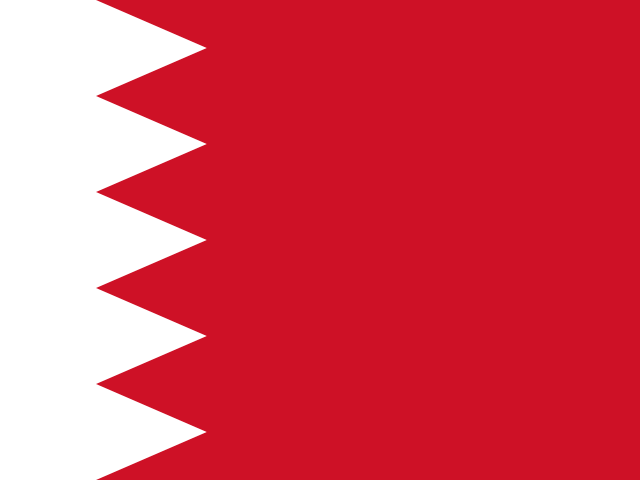 Bahrain
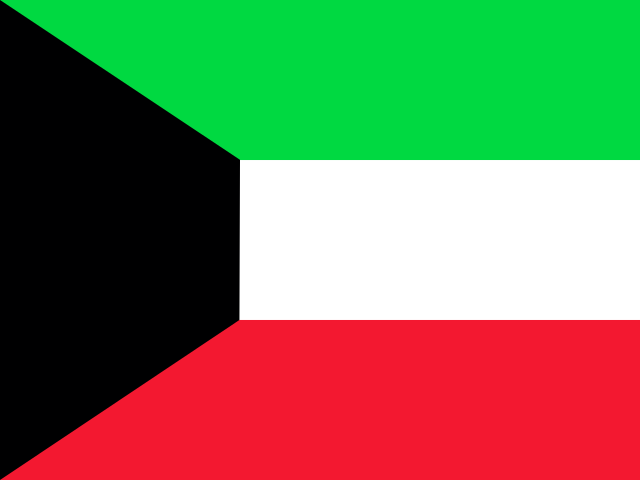 Kuwait
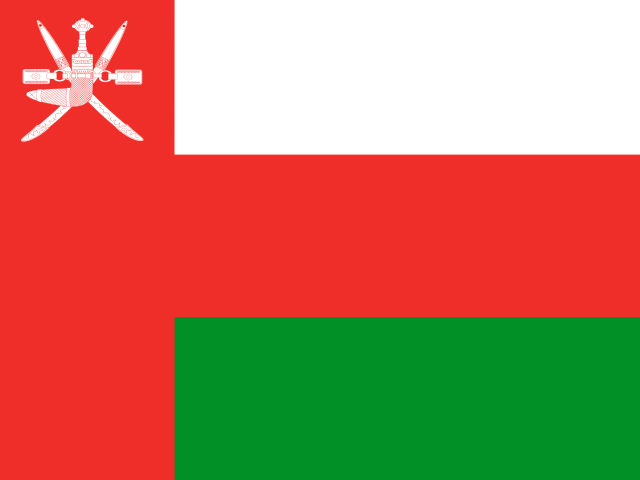 Oman
OmanSaudi Arabia: the words on the flag
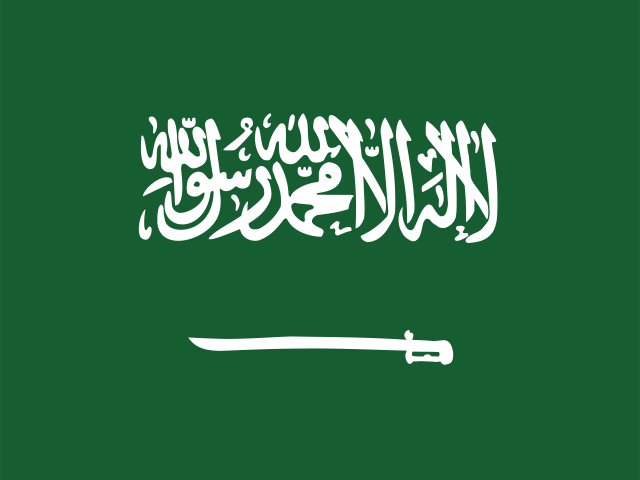
The flag of Saudi Arabia is green with the shahada, the Islamic declaration of faith, written in white Arabic script above a horizontal sword. Because the text is sacred, the flag is never lowered to half-mast, and it is made with two layers so the writing reads correctly from both sides. Green stands for Islam, the sword for justice and strength. Since 2023 the kingdom marks Flag Day every 11 March.
Clue: the only Gulf flag with writing and no stripes.
United Arab Emirates: four colours, one federation
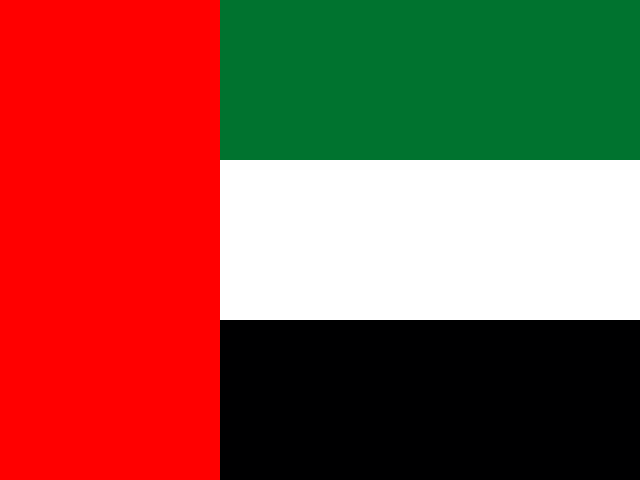
The flag of the United Arab Emirates was raised on 2 December 1971, the day the federation was born. It has a vertical red band at the pole and three horizontal stripes of green, white and black. The design, by a young Emirati named Abdullah Mohammed Al Maainah, uses the pan-Arab colours, often explained by a line of poetry by Safi al-Din al-Hilli: white for our deeds, black for our battles, green for our lands and red for our swords.
Clue: the red band stands upright at the pole, from top to bottom.
Kuwait: the trapezoid
Kuwait raised its flag in 1961, the year of its independence. Three horizontal stripes of green, white and red are joined at the pole by a black trapezoid, a shape no other national flag uses. The colours come from the same pan-Arab tradition as the UAE's.
Clue: both flags have the same four colours, but the UAE has a red band at the pole, while Kuwait has a black trapezoid and green at the top.
Qatar: maroon and nine points
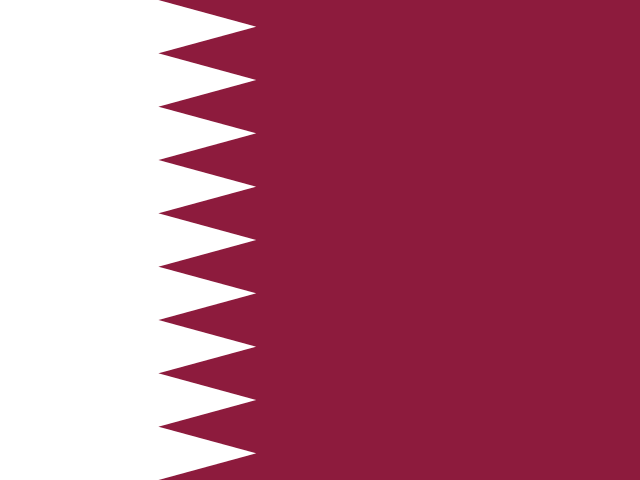
The flag of Qatar is maroon with a white band at the pole, joined by a serrated edge of nine points. The nine points are traditionally explained as Qatar being the ninth member of the reconciled emirates of the Gulf, after its treaty with Britain in 1916. The maroon is said to come from natural dyes that darkened in the sun. With a ratio of 11 to 28, it is the longest national flag in the world compared with its height.
Bahrain: red and five points
The flag of Bahrain looks like Qatar's little brother: a white band at the pole, a serrated edge, and red instead of maroon. Since 2002 it has had five white points, which stand for the five pillars of Islam.
Clue: count the points. Nine and dark maroon means Qatar; five and bright red means Bahrain.
Oman: the emblem in the corner
The flag of Oman is mostly red, with a white stripe above a green stripe on the side away from the pole, and a red vertical band at the pole. In the upper corner sits the national emblem: a curved khanjar dagger over two crossed swords. White stands for peace, green for the fertile mountains of the Jabal Akhdar, and red for the battles of the past. The flag dates from 1970 and was adjusted in 1995.
Clue: the only Gulf flag with an emblem, and its stripes are on the far side.
Why the colours repeat
Red, white, green and black became the colours of Arab nationalism through the flag of the Arab Revolt of 1916, and they spread to Jordan, Palestine, Sudan, Iraq, Egypt, Syria, Kuwait and the UAE. Qatar and Bahrain took another path: their red and white come from older flags of the Gulf coast, when ships and harbours flew plain red banners, later edged in white.
For the other Arab look-alikes, such as Jordan and Palestine, read our guide to look-alike flags.
Play the Gulf
Choose the Gulf flags quiz and see whether you can name all six without a mistake. With only six countries the quiz repeats them across ten rounds, never twice in a row, so every round tests a detail rather than a guess. Then try Hard difficulty, where Qatar and Bahrain come up as each other's wrong option.